Physicochemical Characterization and Toxicological Assessment of Wildfire Smoke Particulate Matter
Wildfire Health Impacts · PM Toxicology · Environmental Health Disparities
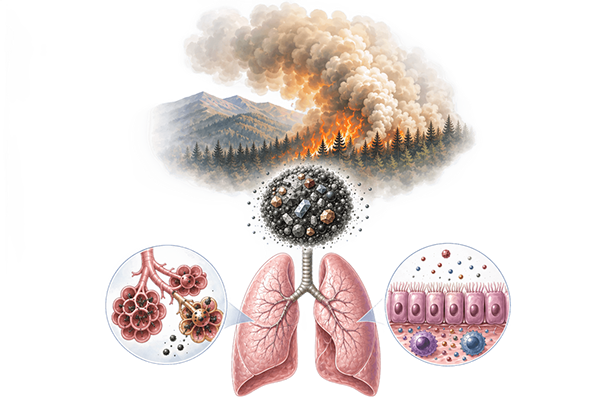
Wildfire smoke is an escalating public health emergency across the Western United States, affecting over 120 million Americans annually — and worsening rapidly. Climate projections indicate a 10-fold increase in extreme fire events by 2100, with disproportionate impacts on vulnerable and underserved communities. Critically, wildfire-specific particulate matter (PM) has been shown to be up to 10 times more toxic than PM from other combustion sources, yet current regulatory frameworks assess exposure based solely on PM mass concentration — a metric that ignores the chemical complexity that actually drives toxicity. Recent findings that wildfire smoke can contain hexavalent chromium — a Class I carcinogen — at 300–13,000 ppb underscore how urgently a chemistry-based, mechanistic approach to wildfire health risk assessment is needed.
10×
Greater toxicity of wildfire PM vs. other combustion sources
120M+
Americans affected by wildfire smoke exposure annually
13,000 ppb
Maximum hexavalent chromium (Class I carcinogen) detected in wildfire smoke
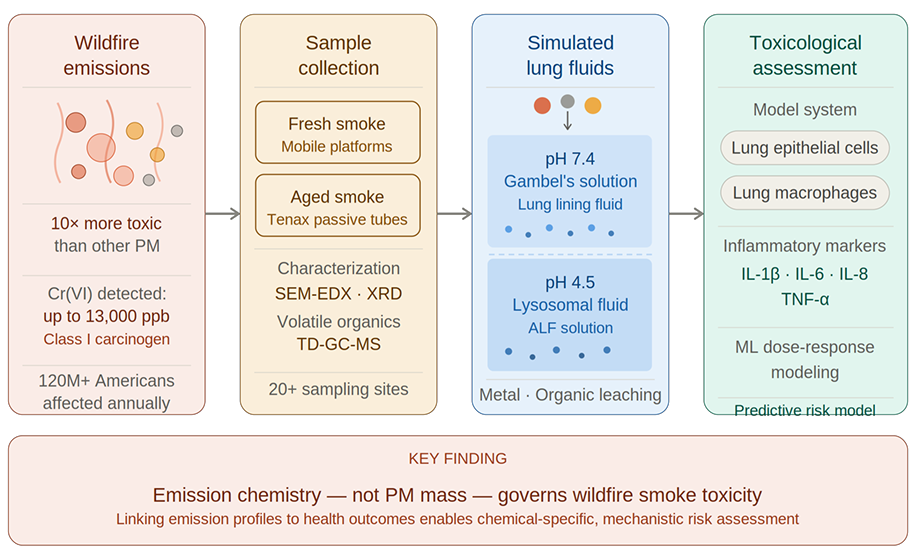
We hypothesize that the physicochemical composition of wildfire emissions governs toxicant leaching into lung fluids, and thereby controls bioavailability and biological toxicity. Our integrated program links multi-platform field sampling to mechanistic laboratory assessment across two aims. In Aim 1, we collect fresh and atmospherically aged smoke across 20+ sites in New Mexico, Idaho, and collaborating Western states, characterizing particulate matter by SEM-EDX and X-ray diffraction, and volatile organic compounds by thermal desorption GC-MS in collaboration with Dr. Nancy Johnston (Lewis-Clark State College). In Aim 2, we quantify metal, metalloid, and organic compound leaching from collected PM using physiologically relevant simulated lung fluids (Gambel's solution, pH 7.4; Artificial Lysosomal Fluid, pH 4.5), followed by in vitro exposure of human lung epithelial cells and quantification of inflammatory biomarkers (IL-1β, IL-6, IL-8, TNF-α). Machine learning-based dose-response modeling is integrated through collaboration with Dr. Jeon (New Mexico State University). Together, this work will produce the first comprehensive database linking wildfire emission profiles to toxicity endpoints — establishing a chemistry-driven health risk framework to inform EPA standards and protect vulnerable communities.
ADMINISTRATIVE ASSISTANT
GAYAN R. RUBASINGHEGE
Associate Professor of Chemistry
New Mexico Institute of Mining and Technology
Department of Chemistry
801 Leroy Place
Socorro, NM 87801
Bethany Jessen
New Mexico Institute of Mining and Technology
Department of Chemistry
801 Leroy Place
Socorro, NM 87801
Phone: 575-835-5129
Fax: 575-835-5215
Phone: 575-835-5263
Fax: 575-835-5364
Copyright © 2018 The Environmental Chemistry Research Research Group. All rights reserved.