Toxicity, Mechanisms and Human Health Effects of Airborne Mine Dust
Occupational & Environmental Health · Respiratory Toxicology · Mining Safety
Inhalation of respirable mine dust is among the most serious and persistent occupational health crises in the United States. Black lung disease (coal workers' pneumoconiosis, CWP) is resurging at rates not seen in decades, and over 50% of annual respirable crystalline silica samples collected from U.S. metal and nonmetal mines exceed the regulatory action level. In April 2024, MSHA issued a landmark final rule lowering the permissible exposure limit for respirable crystalline silica to 50 µg/m³ — underscoring the urgent need for mechanistic, mineralogy-informed toxicological data to support both regulatory standards and worker protection strategies. Beyond silica, mine dusts from uranium, coal, metal, and aggregate operations carry complex mixtures of toxic oxides, heavy metals, and radioactive species whose bioaccessibility and synergistic health effects are poorly understood.
> 50%
of U.S. metal/nonmetal mine silica samples exceed the 25 µg/m³ action level`
50 µg/m³
New MSHA permissible exposure limit for respirable crystalline silica
4 mine types
Uranium · Coal · Metal/Nonmetal · Aggregate — all now part of our research program
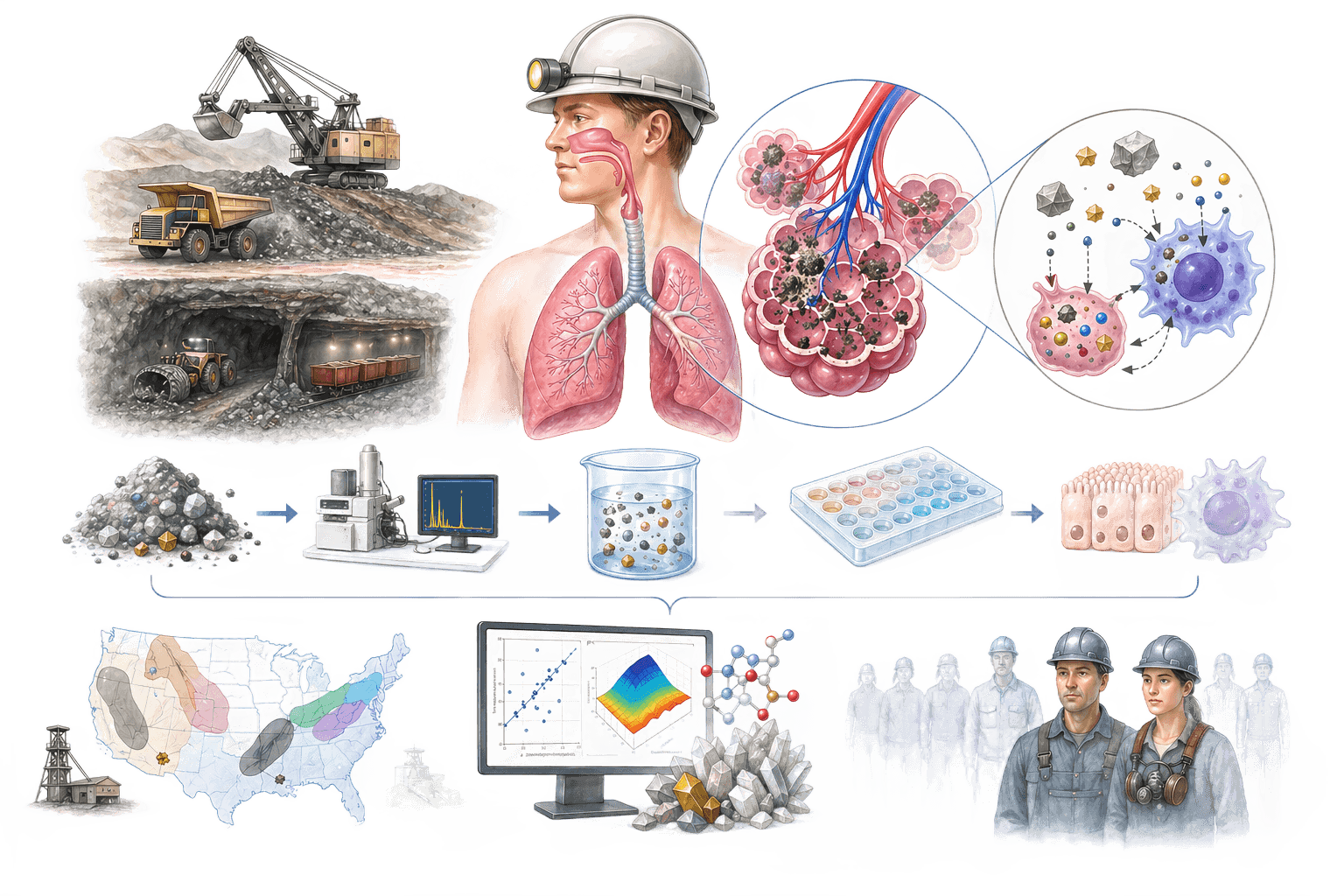
Our central hypothesis is that the chemical toxicity of airborne mine dust is governed by the mineralogy-controlled dissolution of toxic metals and silica species in lung fluids, and the subsequent biological uptake and disruption of essential metal pathways in human cells. To test this, we collect authentic respirable dust from active and legacy mine sites — spanning uranium mines in the Southwest (Jack Pile, San Juan), underground and surface coal mines across the Appalachians and Rocky Mountains, and metal/nonmetal and aggregate mines nationally — and subject them to a rigorous three-stage assessment: physicochemical characterization, bioaccessibility quantification in simulated lung fluids, and in vitro toxicological evaluation using lung epithelial cells and macrophages. Geochemical modeling (PHREEQC) is integrated throughout to predict dissolution behavior and extrapolate findings across mineralogically distinct sites. This work is funded by the National Institute for Occupational Safety and Health (NIOSH).
Mine types and dust sources under investigation
Uranium mines
Underground coal mines
Surface coal mines
Metal & nonmetal mines
Aggregate mines
Integrated research approach
Dust characterization
Mineralogy, elemental composition, particle size, and morphology of authentic and lab-created respirable fractions
Bioaccessibility
Dissolution of toxic metals and crystalline silica in simulated lung fluids (SLFs) under physiologically relevant conditions
In vitro toxicology
Acute and sub-chronic cytotoxicity, oxidative stress, and inflammatory response in lung epithelial cells and macrophages
Geochemical modeling
PHREEQC-based prediction of mineral solubility and metal speciation to generalize findings across mining districts
ADMINISTRATIVE ASSISTANT
GAYAN R. RUBASINGHEGE
Associate Professor of Chemistry
New Mexico Institute of Mining and Technology
Department of Chemistry
801 Leroy Place
Socorro, NM 87801
Bethany Jessen
New Mexico Institute of Mining and Technology
Department of Chemistry
801 Leroy Place
Socorro, NM 87801
Phone: 575-835-5129
Fax: 575-835-5215
Phone: 575-835-5263
Fax: 575-835-5364
Copyright © 2018 The Environmental Chemistry Research Research Group. All rights reserved.